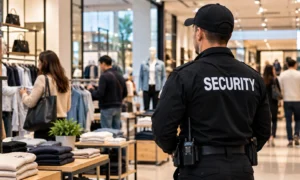


Retail businesses face a range of risks that can affect inventory, revenue, employees and customers. Shoplifting, employee theft, fraud, suspicious activity and inventory discrepancies can all contribute to retail losses.
A Retail Loss Prevention Officer is trained to help retailers identify and respond to these risks while maintaining a safe and professional shopping environment.
Unlike a general security role, loss prevention focuses specifically on reducing retail losses and identifying activity that could affect a store’s stock, property or operations.
Key Takeaways
- Retail Loss Prevention Officers focus specifically on reducing retail losses.
- Their duties can include surveillance, monitoring, incident reporting and theft prevention.
- Officers may work in uniform or plain clothes depending on the retailer’s requirements.
- Loss prevention involves more than responding to shoplifting incidents.
- Officers can work alongside store employees, management and other security personnel.
- A tailored retail loss prevention service can help businesses address their specific security risks.
What Is a Retail Loss Prevention Officer?
A Retail Loss Prevention Officer is a security professional who helps retailers identify, deter and respond to activities that may result in financial or inventory losses.
Their responsibilities can vary depending on the store, products, location and security risks.
Common duties may include:
- Monitoring customers and store activity
- Identifying suspicious behaviour
- Deterring shoplifting
- Monitoring high-risk areas
- Conducting security observations
- Responding to suspected theft
- Preparing incident reports
- Supporting store management
- Monitoring CCTV where required
- Helping protect employees, customers and property
The role is focused on prevention and observation, but officers must also follow the retailer’s procedures and applicable laws when responding to incidents.
What Are the Main Duties of a Retail Loss Prevention Officer?
1. Monitor Store Activity
One of the main responsibilities is maintaining awareness of what is happening throughout the store.
Officers may monitor:
- Store entrances and exits
- High-value product areas
- Self-service areas
- Fitting rooms
- Stockrooms
- Checkout areas
- Other locations identified as higher risk
The goal is not simply to watch customers. Effective loss prevention involves identifying unusual patterns or behaviour that may indicate a security concern.
2. Deter Shoplifting
A visible security presence can discourage opportunistic theft.
Depending on the retailer’s requirements, an officer may be positioned in areas where their presence provides an effective deterrent.
In some retail environments, loss prevention officers may also work in plain clothes so they can observe store activity without creating an unnecessarily intrusive customer experience.
3. Identify Suspicious Behaviour
Loss prevention officers are trained to pay attention to behaviour and circumstances that may indicate potential theft or another security issue.
This can include:
- Unusual activity around high-value products
- Repeated movement through the same areas
- Suspicious interactions
- Attempts to conceal merchandise
- Unusual activity around exits
- Behaviour that conflicts with normal shopping patterns
Identifying a concern does not automatically mean someone has committed an offence. Officers need to follow appropriate procedures before taking further action.
4. Monitor High-Risk Areas
Different parts of a retail store can present different security challenges.
For example, retailers may identify particular risks around:
- High-value merchandise
- Stockrooms
- Delivery areas
- Checkout zones
- Self-service registers
- Store exits
- Fitting rooms
Loss prevention officers can focus their attention on these areas based on the retailer’s risk assessment and incident history.
5. Respond to Suspected Theft
When a suspected theft occurs, the officer can follow the retailer’s established procedures.
Depending on the circumstances, this may involve observing the situation, communicating with store management, documenting the incident and taking further action where legally appropriate.
The response should always be proportionate and consistent with applicable requirements and the security provider’s procedures.
6. Prepare Incident Reports
Accurate reporting is an important part of loss prevention.
Following an incident, an officer may document:
- Date and time
- Location
- Description of the incident
- Merchandise involved
- Relevant observations
- Actions taken
- Witness information where appropriate
- Follow-up requirements
These records can help retailers identify recurring patterns and review their security procedures.
7. Work With Store Employees and Management
Retail Loss Prevention Officers do not work independently of the store.
They may communicate with:
- Store managers
- Supervisors
- Retail employees
- Security management
- Other security personnel
Good communication allows security concerns to be reported promptly while helping store staff understand the appropriate procedures for different situations.
8. Monitor CCTV and Security Systems
Some retail loss prevention roles include CCTV monitoring or working alongside a CCTV team.
Cameras can help officers monitor areas that cannot be observed directly and review activity when an incident occurs.
However, CCTV is generally most useful when it forms part of a wider security strategy that includes appropriate procedures and trained personnel.
9. Help Protect Employees and Customers
Loss prevention is not only about protecting merchandise.
A retail store also needs to provide a safe environment for customers and employees.
Security personnel can help identify situations that may create safety or security concerns and escalate them according to established procedures.
What Is the Difference Between Retail Loss Prevention and General Security?
Retail Loss Prevention Officers and general security guards can have overlapping responsibilities, but their primary focus can be different.
Retail Loss Prevention | General Security |
Focuses heavily on retail loss | Protects people and property more broadly |
Monitors potential theft and fraud | Monitors overall security risks |
Often works closely with store management | May work across an entire property |
Can monitor high-risk merchandise areas | May patrol entrances, common areas and external areas |
Reviews retail-specific incidents | Handles a broader range of security incidents |
For some retailers, both functions may work together.
For example, a shopping centre may have general security covering common areas while individual retailers use dedicated loss prevention personnel for their stores. Avatar’s existing shopping centre guidance makes this distinction between centre-wide security and individual store security.
Do Retail Loss Prevention Officers Work in Plain Clothes?
They can.
The way a loss prevention officer operates depends on the retailer’s requirements and security strategy.
A uniformed officer provides a highly visible deterrent, while a plain-clothes officer may be able to observe customer and staff activity more discreetly.
The appropriate approach depends on factors such as the type of store, previous incidents, product value, customer environment and the retailer’s objectives.
When Should a Retailer Consider Loss Prevention Services?
Retailers may consider dedicated loss prevention when they experience:
- Repeated shoplifting
- High inventory losses
- Fraud concerns
- Theft involving high-value products
- Suspicious internal activity
- Security issues during peak trading periods
- Multiple incidents that require closer monitoring
The appropriate level of security should be based on the retailer’s specific risks rather than applying the same approach to every store.
Avatar Security provides Retail Loss Prevention Officers as part of its retail security services, with a focus on reducing theft and fraud in retail environments.
How Can Retailers Support Loss Prevention Officers?
Security personnel work more effectively when they have clear procedures and cooperation from store staff.
Retailers can support loss prevention by:
- Establishing clear reporting procedures
- Identifying high-risk areas
- Training employees on security procedures
- Reviewing previous incidents
- Maintaining appropriate CCTV coverage
- Controlling access to stockrooms
- Securing valuable merchandise
- Communicating security concerns promptly
For a broader look at the causes of retail inventory loss, retailers can also review Avatar’s existing guide on retail shrinkage and loss prevention.
Frequently Asked Questions
What is the main job of a Retail Loss Prevention Officer?
The main role is to help reduce retail losses by monitoring store activity, deterring theft, identifying suspicious behaviour, responding to incidents and documenting security concerns.
Do Retail Loss Prevention Officers only deal with shoplifting?
No. Their responsibilities can also include monitoring suspicious activity, protecting high-risk areas, supporting fraud prevention, preparing reports and working with store management.
Can a Retail Loss Prevention Officer monitor CCTV?
Some roles include CCTV monitoring, depending on the retailer’s security setup and the officer’s responsibilities.
Do Retail Loss Prevention Officers wear uniforms?
Not always. Some retailers use uniformed officers for visible deterrence, while others may use plain-clothes officers for discreet observation.
Are Retail Loss Prevention Officers the same as security guards?
They can have overlapping responsibilities, but loss prevention officers are specifically focused on retail-related losses, theft and security risks. General security guards may have broader responsibilities covering people, property and premises.
Does every retail store need a Loss Prevention Officer?
No. The need depends on factors such as the store’s size, location, merchandise, incident history and security risks.
Why Retail Loss Prevention Officers Matter to Retailers
Retail Loss Prevention Officers provide a specialised security role focused on protecting stores from theft, fraud and other sources of loss. Their work combines observation, prevention, incident response and reporting rather than relying on a single security measure.
For retailers experiencing recurring losses or managing higher-risk merchandise, a dedicated retail loss prevention service can provide security personnel focused specifically on the store’s needs.